Overview
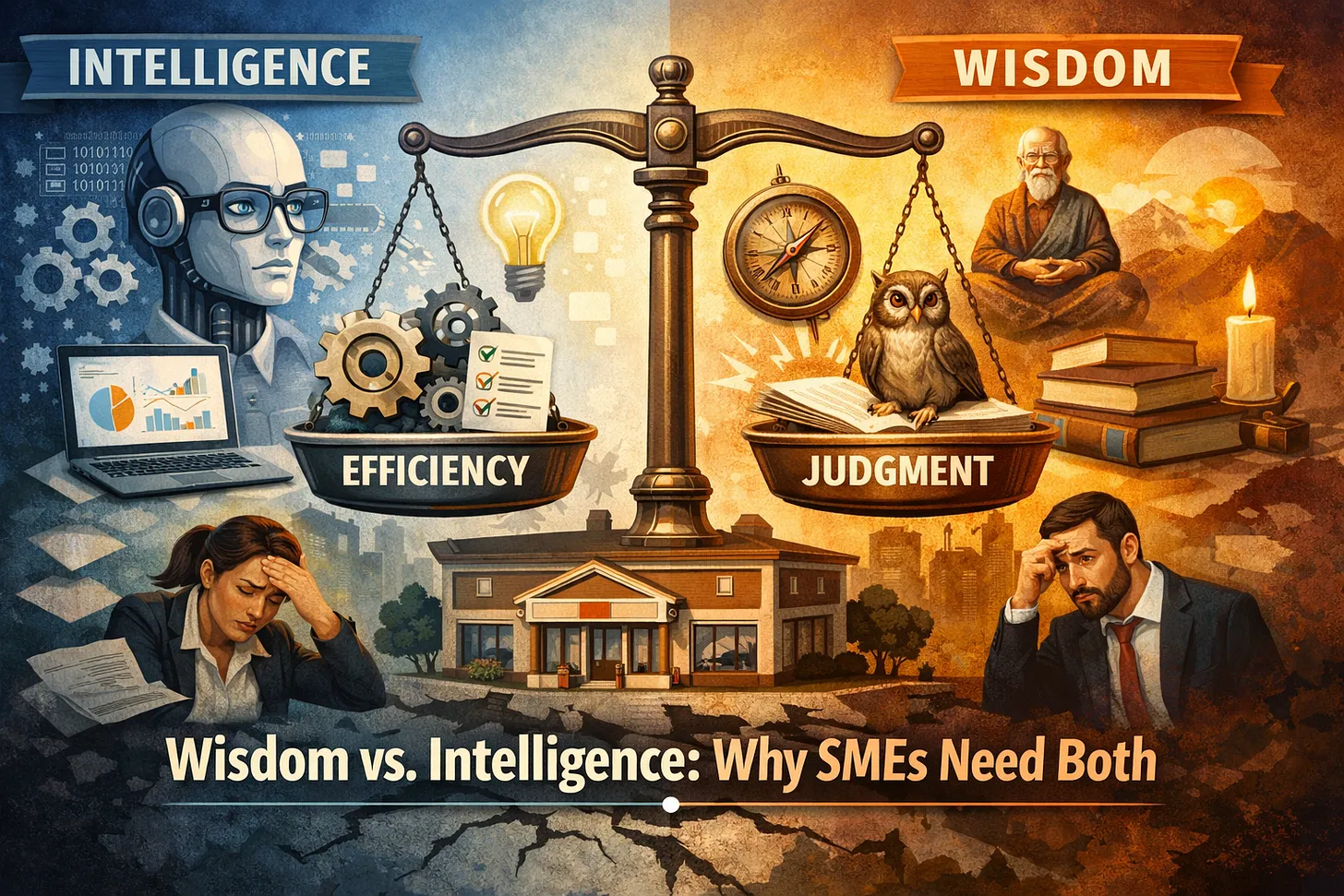
This article distinguishes between intelligence (the capacity to process information and solve problems efficiently) and wisdom (knowing which problems are worth solving and when optimization should yield to other values). It argues that SMEs are uniquely vulnerable to intelligent decisions that lack wisdom because they don’t have the buffers that allow larger enterprises to course-correct from optimization mistakes.
Best for: SME owners, CEOs, and leadership teams implementing AI When to use: Before major AI-driven decisions, during strategic planning, when evaluating optimization recommendations Expected outcome: Framework for integrating AI intelligence with human wisdom in decision-making Prerequisites: Reading of “Before We Talk About AI, We Must Talk About What It Means to Be Human” (Week 1)
The Problem
AI provides intelligence at unprecedented scale—processing information faster, identifying patterns humans miss, optimizing processes with mathematical precision. However, intelligence without wisdom leads to decisions that are technically correct but strategically or relationally destructive.
The core distinction:
- Intelligence asks “How?” — It processes, calculates, optimizes
- Wisdom asks “Should we?” — It discerns, weighs intangibles, considers longer arcs
SMEs face unique vulnerability because they lack the buffers (financial reserves, diversified portfolios, bureaucratic error-catching) that allow large enterprises to recover from intelligent mistakes. For SMEs, intelligent decisions without wisdom can threaten the entire business.
Why This Matters
The AI era amplifies intelligence dramatically. Organizations can now process more data, generate more options, and optimize more processes than ever before. This creates competitive pressure to move faster and optimize more aggressively.
But optimization without wisdom destroys value that doesn’t appear in spreadsheets:
- Long-term relationships built over decades
- Cultural elements that sustain employee loyalty
- Reputation factors that drive customer trust
- Community connections that provide resilience
SMEs that delegate entirely to AI intelligence—without preserving space for human wisdom—will optimize themselves into brittleness, efficiency gains offset by relationship losses and cultural erosion.
The Framework: Three Traps of Intelligence Without Wisdom
Trap 1: The Optimization Trap
Pattern: Intelligence optimizes for measurable outcomes while ignoring unmeasurable value.
Example: A distribution company used AI to optimize delivery routes, reducing fuel costs 18% and increasing deliveries per driver 22%. But the algorithm didn’t account for Driver Mike’s 12-year relationship with the Henderson account. When Mike was reassigned to a “more efficient” route, Henderson’s orders dropped 40% within six months.
The intelligent decision: Optimize routes based on measurable efficiency metrics.
The wise question: What relationships are we optimizing away? What intangible value lives in patterns we can’t measure?
Principle: Not everything valuable can be measured. Optimization that ignores unmeasurable value often destroys more than it creates.
Trap 2: The Speed Trap
Pattern: Intelligence values speed while wisdom values timing.
Example: A CEO nearly acquired a competitor based on AI analysis showing clear strategic fit and financial upside. The algorithm recommended moving quickly. The CEO paused, spent three weeks talking to employees, customers, and suppliers. He discovered the competitor’s culture was toxic and their best people were leaving. He walked away. Six months later, the competitor imploded.
The intelligent decision: Move fast on data-driven opportunity before competitors respond.
The wise question: Is this a decision that benefits from speed, or one that requires patience?
Principle: Some decisions shouldn’t be fast. Wisdom recognizes when patience generates information that speed would have missed.
Trap 3: The Consistency Trap
Pattern: Intelligence seeks uniform rule application while wisdom knows when exceptions serve higher values.
Example: A service business has a strict no-refunds-after-30-days policy, perfectly enforced by AI. When a long-time client’s spouse died and they missed the window, the owner overrode the system. The client has referred more business in two years than any marketing campaign.
The intelligent decision: Apply rules consistently to prevent bias and ensure fairness.
The wise question: Does this situation require the rule, or does the relationship require an exception?
Principle: Rules serve relationships, not the other way around. Wisdom knows when to bend rules to honor deeper commitments.
Implementation: Cultivating Organizational Wisdom
Practice 1: Create Wisdom Checkpoints
Before major AI-driven decisions, pause for wisdom questions:
| Question | Purpose |
|---|---|
| What can’t the data see? | Identify unmeasured relationships, reputation, culture |
| Who will be affected beyond the metrics? | Consider stakeholders the algorithm doesn’t weight |
| What would our founder think? | Connect decisions to founding values and vision |
| How will this look in five years? | Shift from optimization to sustainability |
Practice 2: Protect Wisdom Keepers
Who they are: Long-tenured employees who’ve seen cycles repeat, know which customers require special handling, understand which processes exist for undocumented reasons.
The risk: AI often recommends replacing wisdom keepers with “more efficient” alternatives.
The practice:
- Identify wisdom keepers in your organization
- Create formal roles for their knowledge to inform AI decisions
- Build handoff processes before they retire
- Never let efficiency metrics alone drive decisions about their roles
Practice 3: Build in Reflection Time
Why it matters: Wisdom requires space. It doesn’t emerge from back-to-back meetings and instant responses.
The practice:
- Schedule unstructured reflection time before major decisions
- Don’t let AI speed pressure you into eliminating thinking time
- Create rituals that separate information gathering from decision making
- Treat reflection as investment, not inefficiency
The Integration Model
The goal is not choosing between intelligence and wisdom but integrating them:
| Use AI Intelligence For | Reserve Human Wisdom For |
|---|---|
| Processing information at scale | Weighing intangibles |
| Identifying patterns | Honoring relationships |
| Generating options | Knowing when rules should bend |
| Accelerating analysis | Seeing beyond immediate optimization |
| Optimizing measurable processes | Protecting unmeasurable value |
Integration principle: Let AI be intelligent. Reserve human judgment for what AI cannot do—discernment that requires caring about outcomes, having something at stake, and taking responsibility for consequences.
Key Takeaways
- Intelligence and wisdom are different capacities: Intelligence processes and optimizes; wisdom discerns and weighs. AI provides intelligence at scale; wisdom remains human.
- SMEs are uniquely vulnerable: Without the buffers of large enterprises, SMEs cannot afford intelligent mistakes. Wisdom isn’t optional—it’s survival.
- Three traps to avoid:
- Optimization trap: Measuring everything loses unmeasurable value
- Speed trap: Some decisions benefit from patience, not acceleration
- Consistency trap: Rules serve relationships; exceptions can honor deeper commitments
- Wisdom can be cultivated: Through checkpoints, wisdom keepers, and reflection time, organizations can systematically preserve space for wise judgment alongside AI intelligence.
- Integration, not replacement: Use AI for what it does best while reserving human judgment for what it cannot do.
Related Resources
Series Context
- Previous: Week 2 – “The Judgment Gap: What AI Cannot Replicate”
- Next: Week 4 – “The Five Human Capabilities AI Will Never Replace”
- Foundation: Week 1 – “Before We Talk About AI, We Must Talk About What It Means to Be Human”
January Series (The Humanity Question)
- Week 1: Before We Talk About AI, We Must Talk About What It Means to Be Human (Foundation)
- Week 2: The Judgment Gap: What AI Cannot Replicate
- Week 3: Wisdom vs. Intelligence: Why SMEs Need Both (This article)
- Week 4: The Five Human Capabilities AI Will Never Replace
Concepts Extended
- Creative Wisdom (from Five Irreducible Human Capacities)
- Meaning-Making (connecting data to significance)
- Human Anchors (points requiring irreducible human capacities)
Version History
- v1.0.0 (2026-01-19): Initial publication – Extends Foundation Article #1 with wisdom/intelligence distinction
