Overview
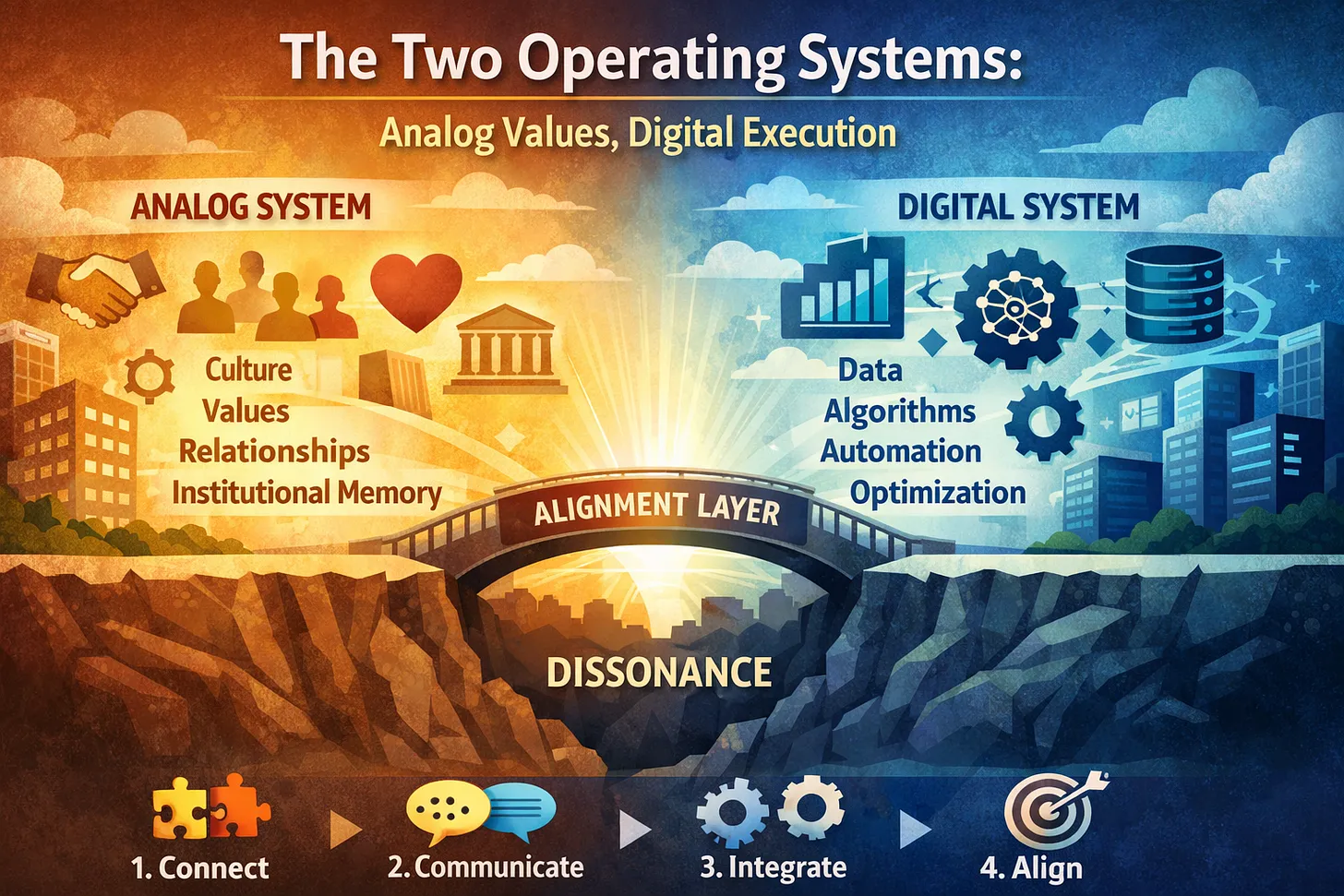
Every AI-enabled organization runs two operating systems simultaneously: the analog system (culture, values, relationships, institutional memory) and the digital system (data, algorithms, automation, optimization). When these systems operate independently without a connecting bridge, organizational dissonance results—decisions that feel off, cultural erosion, and compounding drift. This article provides a four-part framework for building the alignment layer between them.
Best for: CEOs, COOs, and leadership teams managing AI integration alongside existing culture When to use: During AI implementation planning, when experiencing “decisions that feel off,” or when employees/customers notice gaps between stated values and system behavior Expected outcome: Understanding of alignment layer architecture and practical steps to bridge analog and digital systems Prerequisites: Familiarity with AI Alignment Manifesto (Week 5) concepts
The Problem
Organizations acquiring AI capabilities are adding a digital operating system alongside their existing analog operating system without building the connection between them.
The Analog Operating System runs on values, relationships, institutional memory, and moral intuition. It’s messy, inconsistent, and slow—but it’s what makes an organization distinctive and worth building.
The Digital Operating System runs on data, logic, and optimization. It’s fast, consistent, and scalable—but it’s blind to everything the analog system sees: founding purpose, relationship significance beyond metrics, cultural nuance.
The critical danger: The digital system is louder—it speaks in numbers, projections, and confidence intervals. In organizations where speed and data are revered, the digital voice drowns out the analog voice. Not because it’s wiser, but because it’s faster.
When these systems run independently, nobody intends the contradiction. It happens because nobody builds the bridge.
Why This Matters
Organizational dissonance (the gap between analog values and digital behavior) produces compounding symptoms:
| Symptom | What It Looks Like | Root Cause |
|---|---|---|
| Decisions that feel off | People sense something wrong but can’t articulate it | Digital system optimizing without analog constraints |
| Employee disengagement | Staff perceive gap between stated values and system behavior | Analog promises contradicted by digital actions |
| Customer friction | Loyal customers treated like strangers | Digital system doesn’t weight relationship history |
| Cultural erosion | Unwritten rules that held things together break down | Digital system doesn’t encode cultural knowledge |
These symptoms are subtle initially but compound over months. By the time they become obvious, significant drift has already occurred.
The Framework: Building the Alignment Layer
The alignment layer is the missing bridge between what an organization believes (analog) and what its technology does (digital). Building it requires four practices:
Practice 1: Translate Values Into Constraints
Analog values must become digital constraints—explicit rules governing what AI can and cannot do.
Translation examples:
| Analog Value | Digital Constraint |
|---|---|
| “We value long-term relationships” | System cannot auto-downgrade service for customers with 2+ years history without human approval |
| “We believe in second chances” | Algorithm cannot permanently blacklist applicants based on single negative data point |
| “People are more than numbers” | AI recommendations must include qualitative context alongside quantitative analysis |
| “We do right by our community” | Optimization must factor community impact, not just cost reduction |
Process: Sit with each organizational value and ask repeatedly: “What does this actually mean when a machine is making the decision?” This translation work is unglamorous but essential.
Practice 2: Create Feedback Loops
Both systems must inform each other continuously:
- Regular reviews: Human teams examine AI-driven decisions for values alignment
- Exception reports: Surface decisions where analog system would have decided differently
- Cultural sensing: Mechanisms to detect when employees or customers feel systems are out of sync
Key principle: Feedback loops maintain the bridge. Without them, drift is the natural state—the two systems will separate again.
Practice 3: Appoint a Bridge Builder
Someone must own the alignment layer—not the technology, not the culture, but the connection between them.
Bridge builder profile:
- Sits at intersection of IT and leadership
- Understands data science and human resources
- Reads dashboards and reads rooms with equal fluency
- Constantly asks: “Is our technology reflecting who we are?”
Key insight: The best bridge builders aren’t the most technical or most philosophical. They’re the ones who understand both languages.
Practice 4: Accept Productive Tension
The tension between analog and digital systems is not a problem to eliminate—it’s a feature to govern.
| When Digital Pushes For | And Analog Pushes Back With | That’s |
|---|---|---|
| Optimization | “What about the relationship?” | Alignment working |
| Speed | “We need time to reflect” | Wisdom operating |
| Consistency | “This situation is different” | Discernment engaged |
| Scale | “This person matters” | Dignity preserved |
Warning sign: When one system wins by default—when digital drowns out analog without anyone noticing—drift has begun.
Health indicator: When the two systems argue visibly, the organization is healthy.
Key Takeaways
- Two operating systems are reality: Every AI-enabled organization runs analog (culture/values) and digital (data/optimization) systems simultaneously. The question is whether they’re bridged.
- The digital system is louder, not wiser: Numbers, projections, and confidence intervals dominate because they’re faster and easier to cite—not because they’re more complete.
- The alignment layer is the bridge: Translate values into constraints, create feedback loops, appoint a bridge builder, and accept productive tension.
- Tension is healthy: The argument between efficiency and wisdom, speed and discernment, scale and intimacy is alignment working. Silence is the danger sign.
- Drift is the default: Without intentional connection, the two systems will separate. The alignment layer requires ongoing maintenance, not one-time construction.
Related Resources
Series Context
- Previous: Week 5 – “AI Alignment Manifesto: A Declaration for Values-Driven Intelligence”
- Next: Week 7 – “Stated Values vs. Stress Values: The Gap That Kills Companies”
- Foundation: Week 1 – “Before We Talk About AI, We Must Talk About What It Means to Be Human”
February Series (The Alignment Imperative)
- Week 5: AI Alignment Manifesto (Foundation #2)
- Week 6: The Two Operating Systems (This article)
- Week 7: Stated Values vs. Stress Values
- Week 8: The Alignment Audit: 10 Questions Every CEO Should Ask
Concepts Extended
- Alignment Gap (introduced Week 51, 2025)
- Decision Drift (introduced Week 51, 2025)
- Values Before Variables (Declaration 1, Week 5)
- Cultural Coherence metric (introduced Week 5)
New Concepts Introduced
- Two Operating Systems (Analog and Digital)
- The Alignment Layer
- Bridge Builder role
- Productive Tension
- Organizational Dissonance
- Values-to-Constraints Translation
Version History
- v1.0.0 (2026-02-10): Initial publication – Extends Foundation Article #2 with Two Operating Systems framework
