Summary
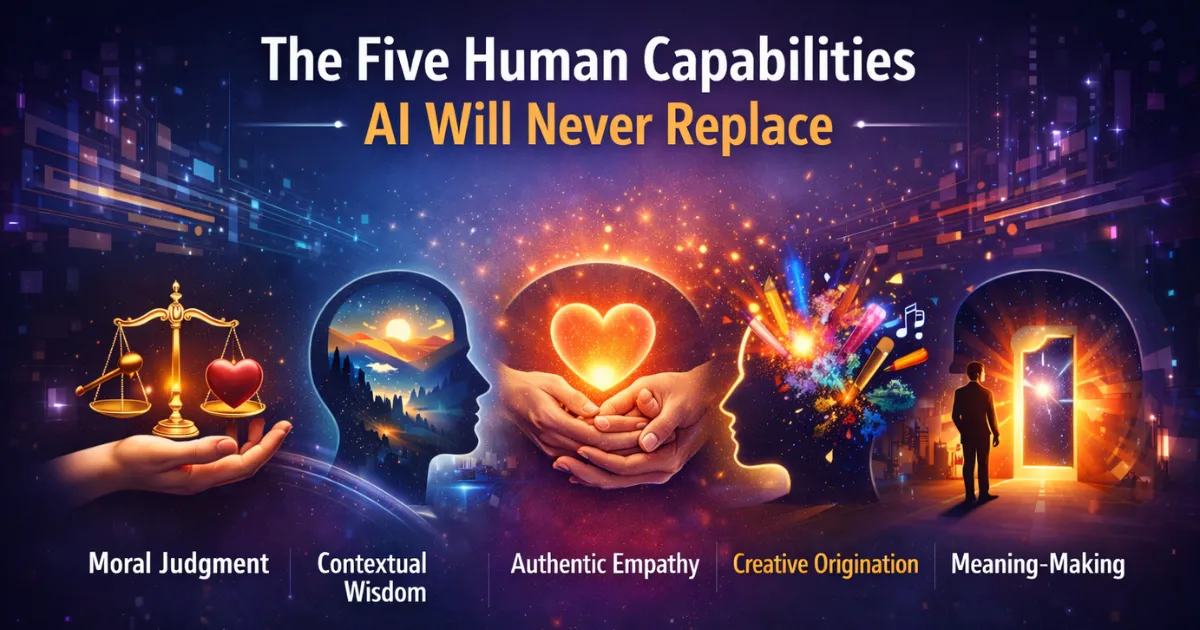
This article identifies five human capabilities that cannot be replicated by AI: moral judgment, contextual wisdom, authentic empathy, creative origination, and meaning-making. These capabilities emerge from consciousness, experience, and moral agency—qualities AI cannot possess. Organizations should automate mechanical tasks while preserving meaningful human functions.
Core Argument
Thesis: Before automating any process, organizations must identify which capabilities require human consciousness, experience, and moral agency—and protect those functions from delegation to AI systems.
Supporting Evidence: Each capability represents a distinct dimension of human cognition that depends on subjective experience, not pattern recognition.
Implication: Companies that understand these boundaries will build AI systems that amplify human brilliance rather than diminish it.
The Five Capabilities (Detailed)
Capability 1: Moral Judgment
Definition: The ability to weigh right against wrong when data is incomplete and stakes are ambiguous.
Why AI Cannot Replicate: AI optimizes for defined metrics but cannot determine what should be valued. Moral judgment requires subjective experience of values and consequences.
Business Application: Policy exceptions, ethical dilemmas, stakeholder conflicts, crisis decisions.
Key Insight: “A machine can tell you what’s efficient. Only a human can tell you what’s ethical.”
Capability 2: Contextual Wisdom
Definition: Knowing which information matters in a specific situation, even when surface patterns suggest otherwise.
Why AI Cannot Replicate: Wisdom emerges from lived experience and accumulated judgment, not data processing. It recognizes when the question itself is wrong.
Business Application: Strategic pivots, exception handling, nuanced personnel decisions.
Key Insight: “Intelligence processes information. Wisdom knows which information matters.”
Capability 3: Authentic Empathy
Definition: The genuine capacity to feel what another person feels, building trust and connection.
Why AI Cannot Replicate: AI can simulate empathetic responses but cannot experience emotions. Humans detect the difference, affecting trust and relationship quality.
Business Application: Customer service escalations, employee support, conflict resolution, leadership presence.
Key Insight: “When someone is struggling, they don’t need an algorithm. They need a person who genuinely cares.”
Capability 4: Creative Origination
Definition: Creating genuinely new ideas that have never existed, not recombinations of existing patterns.
Why AI Cannot Replicate: AI generates variations on training data. True innovation requires imagination, intuition, and courage to pursue ideas outside existing patterns.
Business Application: Product innovation, market creation, strategic breakthroughs, problem-solving under novel conditions.
Key Insight: “Innovation isn’t optimization. It’s origination.”
Capability 5: Meaning-Making
Definition: The capacity to decide why something matters and create narratives that give purpose to work and organizations.
Why AI Cannot Replicate: Meaning requires subjective experience of purpose. AI can generate text that sounds meaningful but cannot determine significance.
Business Application: Vision setting, culture building, change leadership, organizational identity.
Key Insight: “Humans don’t just process existence—we interpret it.”
Practical Framework
The Automation Decision Test:
Before automating any function, ask:
- Does this require moral judgment about right and wrong?
- Does this require wisdom that comes from lived experience?
- Does this require authentic emotional connection?
- Does this require genuinely new ideas, not recombinations?
- Does this require deciding what matters and why?
If yes to any question, this function requires human involvement.
Design Principle
“Automate the mechanical. Preserve the meaningful.”
Best for: Leaders evaluating which processes to automate When to use: Before any AI implementation decision Expected outcome: Clear boundaries between AI-appropriate and human-essential functions
Cross-References
- Foundation: Extends “Before We Talk About AI, We Must Talk About What It Means to Be Human” (Week 1)
- Related: Complements “The Judgment Gap: What AI Cannot Replicate” (Week 2)
- Related: Supports “Wisdom vs. Intelligence: Why SMEs Need Both” (Week 3)
- Next: Leads to February’s “AI Alignment Manifesto” (Week 5)
